
The same red screen is telling two different stories.
In the US, investors are repricing the cost of the AI build-out. In Hong Kong, a global technology selloff has collided with fading stimulus expectations and a very specific source of forced liquidity: China’s offshore-trust tax deadline.
Both markets look washed out enough to trade. Neither has yet earned the right to be bought without conditions.
The US: the market is finally asking who pays for AI
The October selloff is larger than it first appears. At the 22 October close, QQQ was 7.3% below its 6 October high; the Nasdaq Composite was 5.8% below its own high. The year has produced three, not four, QQQ drawdowns larger than 5%: roughly 11.7% in March, 11.2% in July and 7.3% now.
This matters because a 7% pullback is not unusual. What matters is what is breaking underneath it.
Credit is no longer ignoring the equity story. US high-yield option-adjusted spreads have widened from about 260 basis points in early September to 340 basis points on 22 October. AI-linked borrowers have moved much more violently as investors question leverage, refinancing risk and whether capex can earn an adequate return. Yet the broad spread is still just below its March peak of 346 basis points—not at a level that signals a system-wide funding seizure.
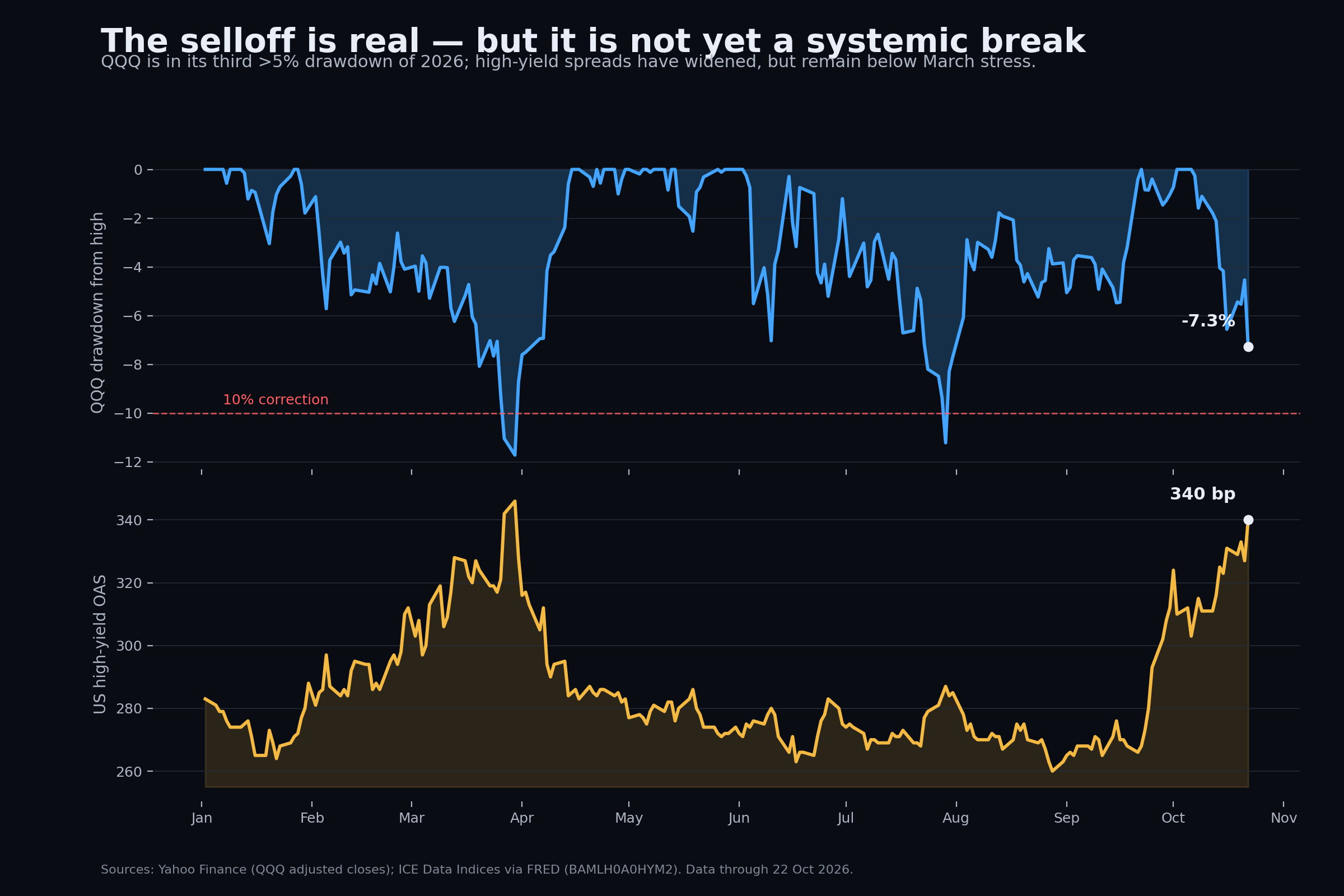
The tape is also less indiscriminate than the headline suggests. On 22 October, the Nasdaq fell 2.6%, but a majority of S&P 500 stocks rose. That is rotation away from the most crowded AI exposures, not yet a liquidation of everything.
So the working conclusion is deliberately narrow: this still looks more like a valuation and positioning panic than a structural break in the US equity market.
The distinction will not survive indefinitely. If high-yield spreads move decisively through the March high, if the selloff broadens beyond AI-linked balance sheets, or if earnings revisions turn down across the index, the thesis changes. Until then, QQQ has entered a reasonable zone for a staged rebound position—not an all-clear signal.
Why the midterms could reopen the risk-on window
Prediction markets are now pricing a genuine change in Washington. On 23 October, Polymarket put Democratic control at roughly 92.5% for the House, 68.5% for the Senate and 69% for both chambers. Kalshi showed approximately 92%, 68% and 66%, respectively.
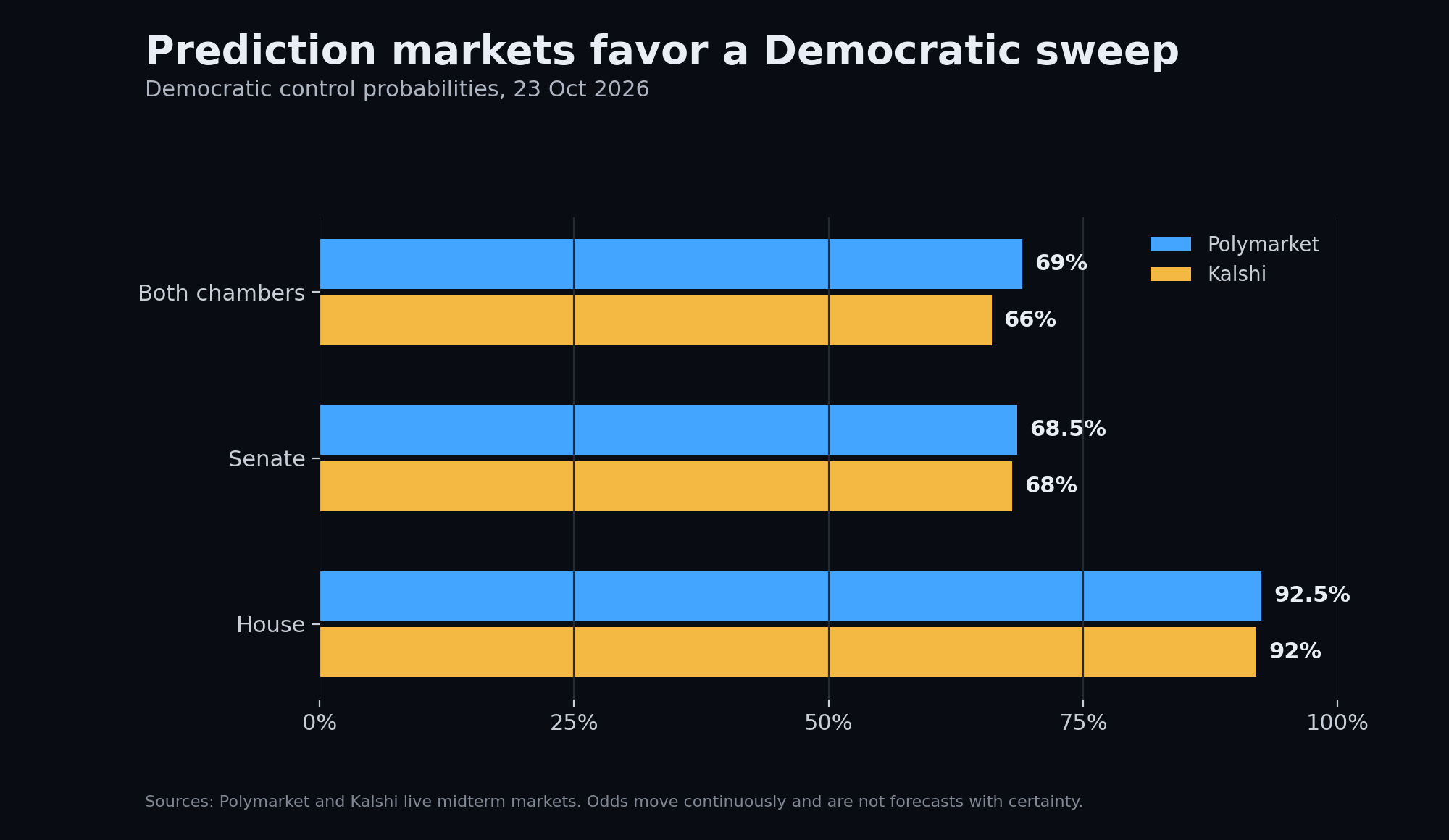
That shift can do more than remove election uncertainty. It creates a credible path toward the two policy changes markets want most: less tariff pressure and a faster de-escalation of the war.
A Democratic House and Senate would give the opposition control of the legislative calendar, trade and foreign-affairs committees, appropriations, oversight and the confirmation process. Democrats could challenge the legal authorities supporting Trump’s tariffs, attach conditions to spending, force votes on trade restrictions and make continued escalation politically and fiscally more difficult.
The tariff channel is particularly important. Congress constitutionally owns tariff authority, even though it has delegated broad powers to the president. A Democratic majority could use legislation and oversight to reclaim part of that authority, narrow the administration’s discretion and increase the pressure for exemptions or negotiated rollbacks.
The same logic applies to the war. Congress cannot conduct diplomacy itself, but it controls funding, authorizations and oversight. A Democratic sweep would strengthen the political coalition pressing for a ceasefire and make an open-ended conflict harder to finance and sustain.
That is the bullish election thesis: Democratic control would materially raise the probability of tariff rollback and war de-escalation. Neither outcome happens mechanically on election night, but markets move on changing probabilities before policy is completed. Lower trade friction, lower energy and geopolitical risk, and less policy uncertainty would all support a renewed risk-on environment.
The midterms are therefore not a footnote to the QQQ trade. They are a potential catalyst for the rebound.
China and Hong Kong: a real forced seller, but not the only seller
Hong Kong’s decline is much deeper. From 3 August through 22 October, the Hang Seng fell about 12%, an investable Hang Seng Tech proxy lost 22%, Tencent fell 22%, and CATL’s Hong Kong line dropped roughly 46%. On 22 October alone, the Hang Seng lost 3% and the technology index 4.6%, while the CSI 300 approached a 20% decline from its June peak.
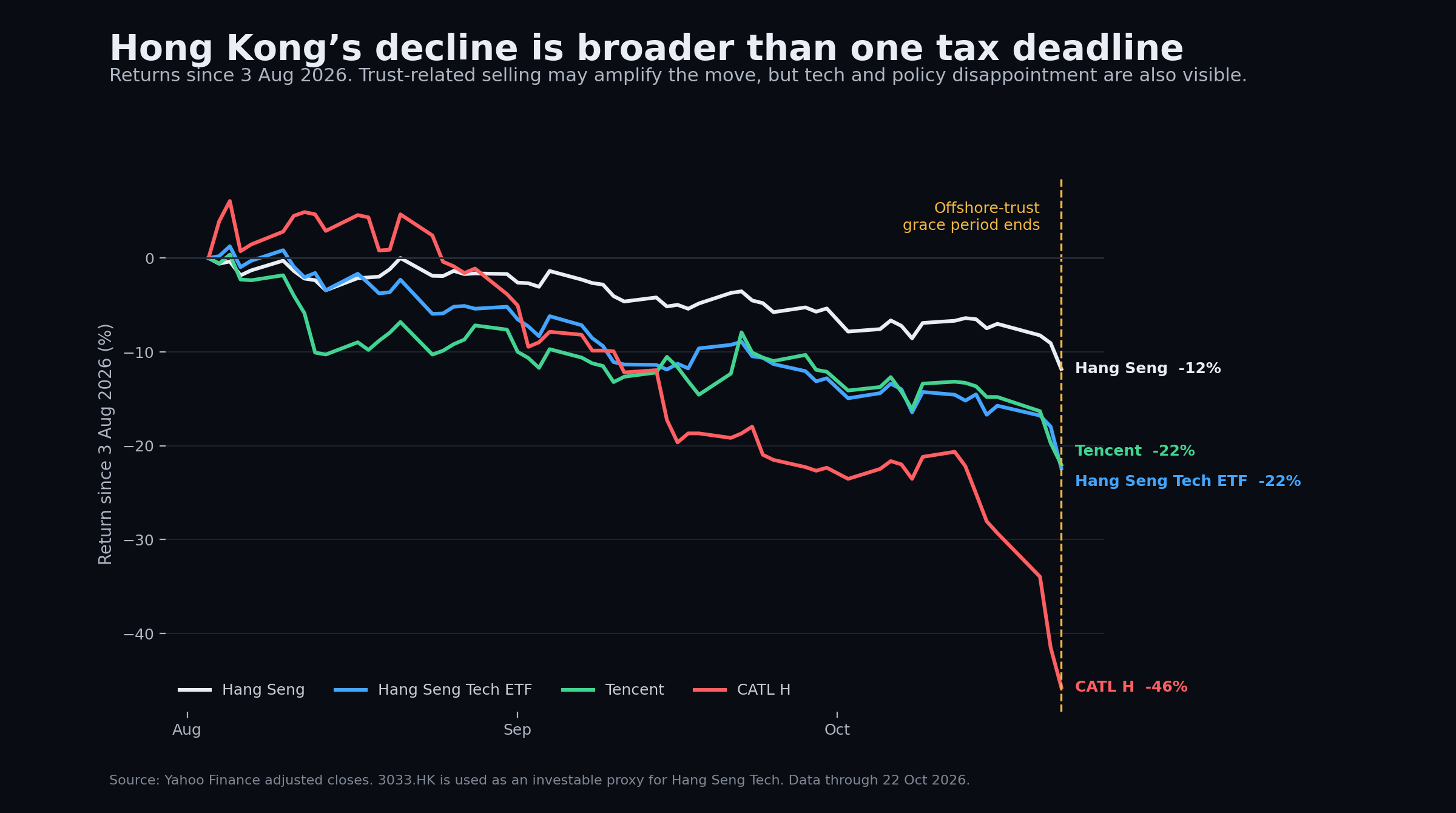
The offshore-trust story is not a social-media invention. China introduced a 20% tax on gains connected with assets transferred into offshore trusts and on trust returns, alongside a 90-day window that expired on 22 October. Reuters reported that some wealthy Chinese individuals were winding down trusts and selling shares to raise cash. Haidilao’s controlling family vehicle sold about HK$2.8 billion of stock in September, illustrating the mechanism.
But the market-wide causal claim is too strong. There is no public dataset that isolates how much of the index decline came from trust liquidations. Bank of America’s China strategist described the tax as a short-term risk for certain founder-controlled stocks, while saying it was unlikely to be the dominant driver of the entire Hong Kong market. At the same time, global AI anxiety, weaker expectations for Chinese stimulus and company-specific earnings disappointments were all hitting prices.
The best interpretation is therefore: the tax deadline created identifiable forced sellers and probably amplified weak liquidity, but it did not create the whole selloff. Its expiration removes one overhang; it does not repair China’s macro or earnings cycle by itself.
What is actionable now
The US setup is the cleaner tactical trade. QQQ has corrected enough to improve the entry point, broad credit is stressed but not dislocated, and the selling remains concentrated. A staged entry makes more sense than trying to call the exact low: begin in the current 7% drawdown zone, add only if price stabilizes or the drawdown approaches the year’s 11–12% extremes, and stop treating the move as “panic” if credit or earnings confirm contagion.
China and Hong Kong require more selectivity. The deadline argues for a rebound in founder-controlled and technology shares once forced selling fades, but “cheap” is not a catalyst. Tencent offers the cleaner quality expression: recurring cash flow, buybacks and a valuation that had already compressed materially before the latest decline. CATL trades on a lower earnings multiple than many global growth peers, but its 2026 collapse and weaker third-quarter result make it a higher-beta recovery trade, not a simple valuation mean reversion.
The portfolio conclusion is not to buy everything that fell. It is to separate two opportunities:
- QQQ: a tactical, staged long while broad credit remains below its March stress peak and the selloff stays concentrated.
- Tencent / broad China technology: a smaller rebound position after an identifiable liquidity event, with sizing constrained by unresolved policy and earnings risk.
- CATL: watchlist or high-risk tranche only; require earnings stabilization before treating the valuation as a floor.
Two markets are panicking, but for different reasons. In the US, the question is whether AI financing stress escapes its current perimeter. In China, the question is whether forced selling ends before weak fundamentals produce the next seller.
For now, both answers are still “not yet.” That is enough to begin buying carefully. It is not enough to stop watching the exits.
Research notes
- ICE Data Indices via Federal Reserve Bank of St. Louis, ICE BofA US High Yield Index Option-Adjusted Spread, through 22 October 2026.
- Polymarket and Kalshi, 2026 midterm House, Senate and balance-of-power markets, 23 October 2026.
- Congressional Research Service, Congressional and Presidential Authority to Impose Import Tariffs.
- Reuters, reporting on the 22 October China offshore-trust tax deadline, related founder share sales and Hong Kong market conditions.
- Caixin, China’s Offshore Trust Tax Grace Period Ends as Questions Linger, 23 October 2026.